Enchanting Enamels: Three Brands That Keep The Magic In House
Bejeweled is happy to publish this piece by art historian and writer Odette Lopez. You can read more of her writing at Substack – By Odette
It’s no secret that enameling continues to fascinate jewelry lovers with its color and vibrancy. A craft that dates back more than 3,500 years, the earliest known examples of vitreous enamel (powdered glass fused to gold) originated during the Mycenaean period in Greece and Cyprus, with techniques such as cloisonné and champlevé being developed during the Byzantine and Roman periods.
Collectors of antique jewelry might be most familiar with the different types of enameling used during the rebellious Art Nouveau movement (1885-1910) which approached jewelry and all the decorative arts with a welcome fluidity and artistic expression. During the period there were sometimes four types of enameling in a single piece: plique-à- jour, guilloché, cloisonné and champlevé.
Today, jewelry enamel is being kept alive by master artisans and designers who have dedicated hours of labor and years of study to create elegant, timeless works of art. It is both a technique and a craft, one that requires patience, precision, and artistry in equal measure.
While many brands opt to send their pieces out for the enameling process, three brands are keeping the magic in-house!
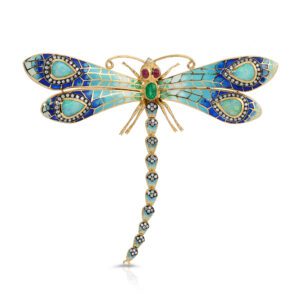
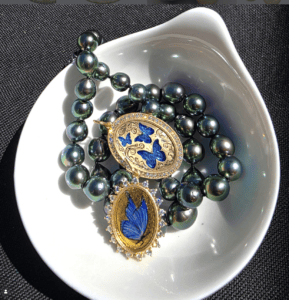
Lord Jewelry’s Butterfly pedant/brooch
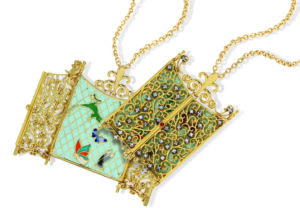
Lord Jewelry’s Secret Garden Pendant
LORD JEWELRY
Lord Jewelry is an independent, family-run atelier located in Downtown Los Angeles, headed by the master jeweler Sinork Agdere and his daughter, Lena. The father-daughter duo makes up one of the few designers who handle all enameling on-site, specializing in the meticulous and labor-intensive technique that is handmade plique-à-jour enamel jewelry. French for “letting in daylight,” this delicate technique of vitreous enamel was popularized by René Lalique during the Art Nouveau movement and is known for creating a translucent effect, like light passing through stained glass windows. Lord’s pieces are a joy to look at due to their both intricate and playful use of color and shape.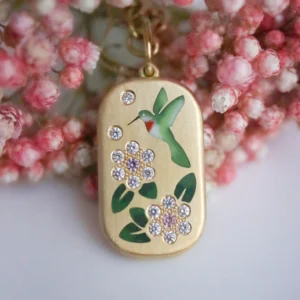
Gwen Barba’s Hummingbird Pendant

Gwen Barba’s Daffodil Pendant and Seedling Pendant
GWEN BARBA
Nature and ephemerality blend together in Gwen Barba’s minimalist approach to the art of vitreous enamel. With an MFA in painting and printmaking from the Rhode Island School of Design, Gwen’s jewelry-making focuses on creating subtle layers and shifting color gradients. Inspired by the atmospheric hues and compositions of Japanese woodblock prints, each piece is handcrafted in her Los Angeles studio using the champlevé technique, in which vitreous enamel powder is carefully layered onto etched or carved gold cells and fired multiple times. The process achieves the soft, nuanced, yet rich colors that define her brand’s style. The Butterfly Sunrise Pendant, part of her recently debuted collection Drift, perfectly showcases this focus on color, shading, and form. In Gwen’s hands, the ancient technique of champlevé emerges in a modern, feminine twist that celebrates delicate beauty.
Erica Molinari’s butterfly pendants.
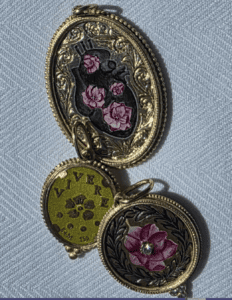
Erica Molinari’s floral pendants
ERICA MOLINARI
While Erica Molinari established her eponymous brand in 2005, she has only just recently introduced enamelling and engraving to her vast repertoire! Her dainty charms feature hand-painted vitreous enamel miniatures set into 18k gold frames. With influences ranging from the Medieval to the Victorian period, her pieces incorporate animals, celestial symbols, and florals with inscriptions and diamond accents to create meaningful jewels. What’s more, Erica keeps the magic of enamelling in her New York studio. She begins by preparing the enamel (mixing the powder and rinsing the grains multiple times), preparing the metal, then uses a fine paint brush to “wet pack” the base color enamel onto the piece, firing in the kiln with each layer applied. The piece must then be stoned down to a fine matte finish, refired to a glossy finish, all in preparation to paint. Next, finely ground enamels are mixed with oil, blended to achieve the desired color (think oil painting). Then, using a fine paint brush, the paints are applied layer by layer to develop color, saturation, and to define the features of the painting. Each layer is then fired in the kiln until it is deemed finished.
Two beautiful examples of pieces designed by the major proponents of the Art Nouveau Period
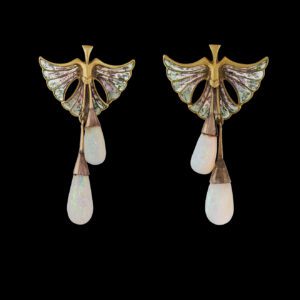
Watski’s Pair of Earring by George Fouquet, Paris,circa 1905
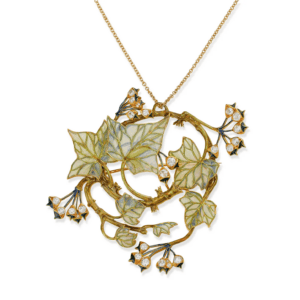
Below; Macklowe Gallery’s René Lalique “Ivy” Pendant Brooch/Necklace